
The short answer is genuinely no: you do not need an electricity distribution licence to sell charging. The Ministry of Power’s position is that EV battery-charging activity is de-licensed nationally, provided the applicable technical, safety and operating requirements are followed.
That last clause is where the whole subject lives, and it is the part that gets dropped when the answer is repeated. De-licensed means you do not need a licence to supply electricity as a business. It does not mean you can energise a charger on a plot without anyone’s permission.
What you actually have to obtain
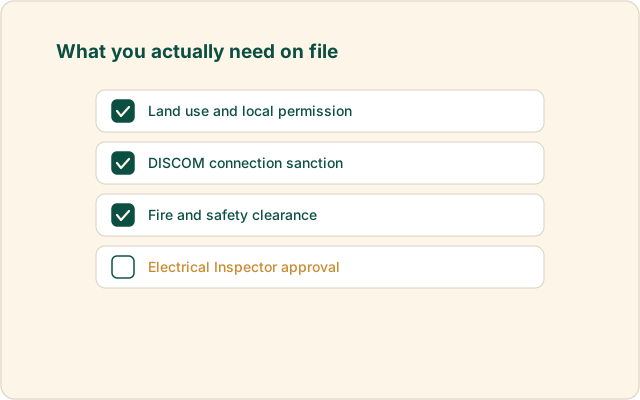
Across the jurisdictions we have verified against primary sources, the same four categories recur, though the authority, the form and the fee differ in each.
1. The electricity connection
The one nobody can skip. You are applying to your distribution licensee — the DISCOM for your area — for a connection at an appropriate tariff category and sanctioned load. This is not a formality: it determines your landed cost per unit, your connection charges, and often your project timeline.
Note that “the DISCOM for your area” can itself be a live question. In Maharashtra, for example, most of the state is served by MSEDCL, but Mumbai is split across separate licensed areas served by Adani Electricity, Tata Power and BEST — and the tariff that applies to your premises depends on which licensed area you are in. Confirming the exact licensee and division for your full address is a real step, not a detail.
2. Electrical safety approval and inspection
Typically the Chief Electrical Inspector to Government (or the state equivalent), whose inspection or approval is triggered by the nature of the installation. The trigger conditions and the process vary by state, and in our own state references we flag where the official directory still needs confirmation rather than presenting an assumed process as fact.
3. Local NOCs — fire, municipal, development authority
This is the genuinely parcel-specific layer. Whether a fire NOC or a municipal or development-authority approval is required depends on the site: its use classification, what is adjacent, whether the plot fronts a highway, and what is being built on it. Our state references record this honestly as site-triggered, varies by parcel, because that is what the primary sources support — not a yes or a no that would be wrong for half of readers.
4. Standards and specification compliance
Equipment and installation must meet the applicable standards, and some states layer their own requirements on top. Telangana’s EV policy, for instance, requires private players to set up ARAI-compliant charging and swapping infrastructure, with specifications to be defined by the Transport Department, the State Nodal Agency and the ITE&C Department. We record that with a caveat we think is important: the actual specification documents were not located when we verified it. A stated requirement whose document you cannot find is a question to ask, not a box to tick.
Why we will not give you a national checklist
Because publishing one would be inventing it. The requirements that decide whether your project can proceed — sanctioned load, metering arrangement, tariff category, earthing and safety clearance, local NOCs — are decided at state, DISCOM and municipal level, and they differ enough that a generic list would be wrong somewhere for almost every reader.
What we do instead is verify one jurisdiction at a time against gazettes, tariff orders, DISCOM circulars and regulator publications, archive each document with a retrieval date, and publish what is confirmed — while listing separately what is not yet confirmed rather than filling the gap with a plausible guess.
Eight jurisdictions are published so far, each with the regulator, the DISCOM map, the connection process, safety approvals, tariff, subsidies and forms:
The remaining states and union territories are being verified before publication. We would rather publish eight states you can rely on than thirty-six you cannot.
The practical sequence
- Identify your distribution licensee and division for the exact address, and get the applicable tariff category and current schedule.
- Establish sanctioned load and connection feasibility before committing to a configuration — this is the step that most often changes the plan.
- Ask the DISCOM which approvals they require for your load and premises type, in writing.
- Check the parcel-specific layer — fire, municipal or development authority — against the actual use and the actual plot.
- Confirm the state’s own specification requirements, and get the referenced document rather than the reference to it.
The ordering matters for the same reason it does in site selection: the electrical position can disqualify a project outright, and it is cheap to establish early and expensive to discover late.
Sources
| Claim | Source | Status |
|---|---|---|
| EV battery-charging activity is de-licensed nationally when applicable technical safety and operating requirements are followed | Ministry of Power — national framework [NAT-MOP-2018-001], verified 2026-07-31; site approvals still apply | verified |
| Mumbai is served by multiple licensed areas (Adani Electricity, Tata Power, BEST) while most of Maharashtra is MSEDCL; tariff depends on the licensed area | MERC and licensee sources [MH-TARIFF-2026-001], [MH-DISCOM-WEB-001] | verified |
| Safety approval via Chief Electrical Inspector; fire/municipal NOC is site-triggered and varies by parcel | Our state references, e.g. Telangana approvals | verified, with noted gaps |
| Telangana requires ARAI-compliant infrastructure, specifications to be defined by Transport Dept, SNA and ITE&C | Government of Telangana EV policy [TS-EV-2020-001], verified 2026-08-13 — specification documents not located | verified, document not located |