
Puducherry is regulated by the Joint Electricity Regulatory Commission for Goa and Union Territories, and supplied by the Electricity Department, Government of Puducherry — a government department rather than a distribution company. Its EV rules are better documented than most states, and they contain one fact that changes how you should approach the whole project.
1. A category with no customers
The tariff structure contains a dedicated low-tension category, LTEV-I (EV charging station), carried through the Commission’s category-wise consumer, sales and revenue tables for the 4th multi-year tariff control period, FY 2025-26 to FY 2029-30, set by order dated 24 September 2025.
Across those tables, for all five years, LTEV-I records nil consumers, nil sales and nil revenue. The category exists in the tariff structure and had no consumers billed under it at the date of the order.
2. What the schedule charges
| Category | Energy charge | Fixed / demand charge |
|---|---|---|
| LTEV-I (low tension, EV charging station) | ₹6.05/kVAh | ₹35 per kVA per month |
| HTS-VI (high tension) | ₹6.05/kVAh | ₹100 per kVA per month |
These are FY 2026-27 approved base-schedule amounts. They are not a delivered cost: the actual bill still depends on category, voltage, later orders, adjustment charges, duty and tax, and site-specific confirmation. The register also flags the freshness control explicitly — the archived order is not a substitute for checking JERC’s tariff-order page for later review, true-up, amendment or corrigendum orders immediately before you commit.
One honest caveat carried from the register itself. Alongside these figures, our Puducherry entry holds an open item to re-extract the EV charging station category and rates directly from the multi-year order and confirm the dedicated EV category for the department. We publish the figures as recorded and the open item beside them rather than presenting one without the other.
Two structural points worth carrying into a model:
- Billing is per kVAh, so power factor rides on your bill — the same basis as Chhattisgarh and Maharashtra, and the opposite of Himachal Pradesh’s kWh basis.
- The energy rate is identical on LT and HT; only the fixed charge differs, and it is nearly three times higher on HT — ₹100 against ₹35 per kVA per month. On the published figures alone, a site that can stay within the low-tension ceiling avoids that difference entirely. That is our arithmetic on the schedule, not a rule, and it points straight at the next section.
3. The ceiling nobody else gets
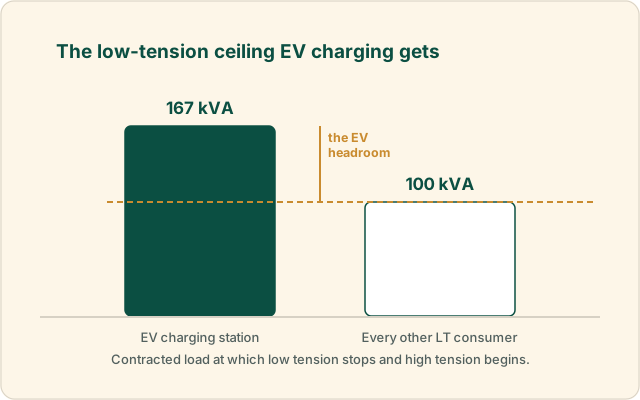
Standard supply voltage is set by contracted load — and EV charging stations are given their own bands:
| Contracted load | Supply |
|---|---|
| EV charging station, above 5 kW up to 167 kVA (150 kW) | 3-phase 4-wire, 440 V — low tension |
| Every other installation at low tension | limited to 100 kVA contracted load |
| EV charging station, above 167 kVA up to 5,000 kVA | High tension — 6.6 kV, 11 kV, 22 kV or 33 kV |
| Above 5,000 kVA | Extra high tension — 66 kV and above |
The practical planning consequence: 167 kVA is a real design boundary. A configuration that lands just above it moves you to high tension, with its own works, metering, inspection and a fixed charge nearly three times higher per kVA. That is worth knowing before you pick charger counts, not after.
4. Four regions, one department
The Union Territory is made up of four geographically separate regions — Puducherry, Karaikal, Yanam and Mahe — and all four route to the Electricity Department. There is no second licensee to identify.
What still needs confirming is narrower but still critical: the exact serving office or section, the available voltage, the sanctioned-load pathway and network feasibility, all from the complete site address. Our register grades the service-area entry medium confidence for that reason — wrong routing invalidates both your cost and your schedule.
The register also carries an open item most state guides do not need: coastal and island logistics, corrosion, weather and flood design inputs, spares and emergency-response constraints. For a coastal site those are engineering questions with real capex and O&M consequences, and they belong in the design brief rather than in a footnote.
5. Clocks with a penalty attached
Puducherry publishes connection timelines, and — unusually — a penalty for missing them.
| Case | Limit |
|---|---|
| New connection or additional load, supply available from the existing network — metro cities | 3 days |
| … urban and municipal areas | 7 days |
| … rural areas | 15 days |
| … rural areas of islands | 30 days |
| Where extension works, transformer enhancement, extension of distribution mains or a new substation is required | immediately after commissioning, and not exceeding 90 days |
| Acknowledgement with registration number, on a complete application | within 24 hours |
| Penalty where the licensee fails to supply within the specified period | up to ₹500 per day of default |
All of these run from an application complete in all respects, which is the usual and important qualification — the mechanics of why published clocks and real projects disagree are in from application to energisation. Applications may be filed in hard copy or electronically; a hard copy must be scanned and uploaded. New connections up to 10 kW need a photograph, identity proof and proof of ownership or occupancy; above 10 kW and for modifications, further documents apply. Where an agreement between licensee and consumer is required it forms part of the application, so no separate agreement is needed.
6. Prepayment metering is mandatory
This is the operational detail most likely to surprise an operator arriving from another state, and it is not optional.
No connection shall be given without a meter, and that meter must be a smart pre-payment meter or a pre-payment meter. Any exception requires the Commission’s approval with recorded justification.
Two related provisions govern demand once the smart meter is in:
- After a smart meter is installed, no penalty may be imposed for maximum demand recorded before the installation date.
- Where recorded maximum demand exceeds sanctioned load in a month, that billing cycle is calculated on the actual recorded maximum demand, the consumer must be informed by SMS or mobile application, and sanctioned-load revision follows where the limit has been exceeded at least three times in a financial year.
7. No UT policy, so no subsidy
No Union Territory-specific EV policy, and no formal State/UT Nodal Agency designation, was established in the located official evidence. As in Himachal Pradesh, the practical consequence is simple: no incentive belongs in the base case. Confirm the lead department and any live incentive or tender programme in writing before you count on one.
The national layer still applies and is worth naming, because it carries obligations rather than benefits: EV charging operation is de-licensed only while the operator follows the applicable national guidelines and other laws; a separate meter and an approved tariff pathway must be confirmed; AC and DC installations must meet the relevant CEA electrical-safety protections, testing and record-retention duties; public charging rates and service charges must be displayed as the national guideline requires; GST and land-cost treatment must not be guessed; and public layouts require an accessibility screen covering route, bay, interface, payment and assistance.
8. The sequence we would follow
- Confirm the serving office or section and the preliminary supply point for the complete address.
- Confirm the category in writing — LTEV-I, HTS-VI or HT-VI as applicable — naming public, captive, fleet or workplace use, connected demand and supply voltage. Given the nil-consumer position, do not assume a routine exists.
- Check JERC’s order page for later orders immediately before commitment, not at the start of the exercise.
- Design against the 167 kVA boundary deliberately, knowing the HT fixed charge is nearly three times the LT one per kVA.
- Size contract demand for simultaneity, given the three-breach revision rule.
- Plan for prepayment metering in the cash-flow model.
- Get the live form list, application fee, security deposit, service-line/augmentation basis and a written timeline — and note that the published clocks carry a ₹500-a-day penalty behind them.
- Confirm electrical-inspectorate jurisdiction, approval threshold, drawing and test requirements, fee and inspection stage.
- Confirm fire, building, land-use, access, signage and road approvals for the exact parcel, and settle the coastal design inputs where they apply.
What is still unconfirmed
Published deliberately. For Puducherry we have not verified from a primary source: the exact serving office, section and preliminary supply point for a complete address (critical); the current category, energy and fixed/demand charges, time-of-day and power-factor terms, duty, tax and adjustment charges for the actual use (critical); whether a new connection, load enhancement, separate meter, LT or HT supply or a dedicated transformer is required (critical); the current form and upload list, application fee, security deposit, service-line and augmentation basis and a written timeline (critical); the electrical-inspectorate jurisdiction, approval threshold, drawings, fee and inspection stage (critical); fire, building, land-use, access, signage and road approvals for the exact parcel (critical); the current UT nodal agency and any live incentive or tender route; coastal and island logistics, corrosion, weather and flood design inputs; and the re-extraction of the EV charging station category and rates directly from the multi-year tariff order.
Sources
| Claim | Source | Status |
|---|---|---|
| LTEV-I (EV charging station) is a dedicated low-tension category carried through the category-wise consumer, sales and revenue tables for the 4th MYT control period FY 2025-26 to FY 2029-30, by order dated 24 September 2025, and records nil consumers, nil sales and nil revenue across those tables | JERC for Goa and UTs multi-year tariff order [PY-JERC-TARIFF-2025-001] | verified |
| FY 2026-27: LTEV-I ₹6.05/kVAh energy and ₹35/kVA/month fixed; HTS-VI ₹6.05/kVAh energy and ₹100/kVA/month fixed, as approved base-schedule amounts | [PY-JERC-TARIFF-2025-001] with [PY-JERC-ORDERS-WEB-001] — an open item to re-extract the EV rate from the order is recorded alongside | verified, with an open item |
| EV charging station above 5 kW up to 167 kVA (150 kW) takes 3-phase 4-wire 440 V low tension, while all other installations are limited to 100 kVA at low tension; above 167 kVA to 5,000 kVA is high tension at 6.6/11/22/33 kV; above 5,000 kVA is EHV at 66 kV and above | JERC Supply Code amendment [PY-SC-AMD3-2024-001] | verified |
| Connection timelines of 3 / 7 / 15 / 30 days by area from a complete application, 90 days maximum where extension works are required, 24-hour acknowledgement, and a penalty not exceeding ₹500 per day of default | JERC Supply Code amendment [PY-SC-AMD3-2024-001] | verified |
| No connection without a meter, which must be a smart pre-payment or pre-payment meter; billing on actual recorded maximum demand where it exceeds sanctioned load, with SMS or app notification and sanctioned-load revision after three exceedances in a financial year | JERC Supply Code amendment [PY-SC-AMD3-2024-001] | verified |
| No UT-specific EV policy or formal nodal-agency designation was established in the located official evidence | Assessed against the national guideline [NAT-MOP-2024-001] | open question |
| De-licensing conditional on following national guidelines, CEA safety duties, display of public charging rates and service charges, and the accessibility screen for public layouts | [NAT-MOP-2018-001], [NAT-MOP-2024-001], [NAT-CEA-2023-001], [NAT-ACCESS-2021-001], [NAT-RPWD-2016-001] | verified |
| The LT-versus-HT fixed-charge comparison, the 167 kVA design-boundary reading and the simultaneity advice | Our arithmetic on the published schedule, and advisory method | advisory opinion |