
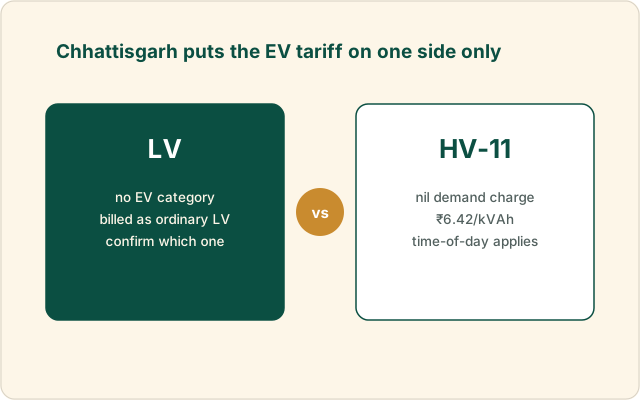
Most state guides open with a tariff comparison. This one has to open with a structural point instead, because in Chhattisgarh it decides everything downstream: the EV charging tariff category exists only at high tension.
1. The gap at low voltage
The FY 2026-27 schedule carries tariff category HV-11, Electric Vehicle Charging Stations, applicable to consumers taking supply at EHV or HV. It provides no dedicated low-voltage EV-charging category. An EV charging installation that takes LV supply must therefore be billed under a regular LV category rather than an EV-specific tariff — and which regular category applies to a dedicated public or captive LV charging station is recorded in our reference as a critical open question, to be confirmed with CSPDCL for the specific site.
2. What HV-11 costs, and when
| Item | Value | Notes |
|---|---|---|
| HV-11 demand charge | Nil | CSPDCL licensed area, FY 2026-27 |
| HV-11 energy charge | ₹6.42/kVAh | Effective 1 July 2026 to 31 March 2027 |
| Solar window 09:00–17:00 | 80% of normal | Equivalent ₹5.136/kVAh before additions |
| Peak 17:00–23:00 | 120% of normal | Equivalent ₹7.704/kVAh before additions |
| Night 23:00–09:00 | Normal rate | ₹6.42/kVAh before additions |
| Metering | ToD or smart meter required | Time-of-day applies to HV-11 |
| Demand above contract demand | 1.5× or 2× normal tariff | Irrespective of time of use |
| Taxes, duty, FPPAS, other charges | Additional at current rates | Obtain the live stack from the licensee |
Two features of this structure are worth planning around rather than discovering.
The overnight block is at the normal rate, not a penalty. The spread runs from ₹5.136 in the solar window to ₹7.704 at peak — the peak rate is 50% above the solar-window rate — but the eight hours from 23:00 to 09:00 sit at the plain ₹6.42. That is a meaningfully different shape from Madhya Pradesh, where the surcharge block runs a full sixteen hours from 17:00 to 09:00 and an overnight depot pays for the privilege. A fleet operator charging vehicles overnight is not penalised in Chhattisgarh the way it is across the border.
The rate is per kVAh, not per kWh. Billing on apparent energy means power factor rides on your bill: poor power factor raises your effective cost per usable unit, and no amount of tariff negotiation fixes it. This is the same basis Maharashtra uses and the opposite of Madhya Pradesh’s genuine kWh rates — worth carrying into the model rather than treating ₹6.42 as if it were a per-kWh number.
One more detail that matters if you are pairing with solar: HV-11 has also been made applicable to the auxiliary power requirement of solar plants taking supply at EHV or HV for FY 2026-27, and to HV consumers opting for the minus-metering facility.
3. Which licensee serves your parcel
Chhattisgarh is not a single-licensee state in the way a district map suggests. CSERC’s current tariff directory lists CSPDCL for statewide distribution, and separately lists distribution-business tariff orders for two special-area licensees:
| Licensee | Role | Confirm |
|---|---|---|
| Chhattisgarh State Power Distribution Company Limited (CSPDCL) | Main distribution utility — supply, connection, metering, billing, network works | Exact parcel division and section |
| Jindal Steel and Power Limited | Licensed distribution business in its authorised area | Whether the parcel sits inside the licensed boundary, and the current tariff |
| SAIL Bhilai Steel Plant | Licensed distribution business in its authorised area | Whether the parcel sits inside the licensed boundary, and the current tariff |
A Raipur site will ordinarily fall in CSPDCL’s area, and our reference treats that allocation as indicative rather than settled, for a specific reason: a licensee area is a legal boundary, not district shorthand. The register’s own instruction is to send the full address, PIN, survey or GPS reference and the nearest consumer number to the regulator and licensees, and have the service boundary confirmed rather than inferred. Getting this wrong routes your application to the wrong office and costs weeks you cannot recover.
4. The table that sizes your connection
Supply voltage is set by contract demand:
| Voltage | Contract demand range |
|---|---|
| 230 V | up to 5 kW |
| 400/440 V | up to 200 HP or 150 kW |
| 11 kV | 60 kVA to 500 kVA |
| 33 kV | 60 kVA to 15,000 kVA |
| 132 kV | 4,000 kVA to 40,000 kVA |
| 220 kV | 15,000 kVA to 150,000 kVA |
Read alongside the Supply Code entry that three-phase 440 V is normally permitted up to 150 kW, there is an overlap band — roughly 60 kVA to 150 kW — where both a low-voltage and an 11 kV connection appear available on the published table. That reading is ours, not the regulator’s, and it is worth putting to the licensee in writing, because in Chhattisgarh that same band is where the EV tariff appears or disappears. A configuration sized just either side of it is a materially different project.
Two billing mechanics to carry into the model. Billing demand for any month is the recorded maximum demand in kVA or 85% of contract demand, whichever is higher, and maximum demand is measured as the highest average kVA over any 15-minute sliding window — so a short burst of simultaneous fast charging sets it. And demand exceeding contract demand is billed at one-and-a-half or two times the normal tariff, irrespective of time of use. How the 85% floor interacts with a nil demand charge is exactly the kind of question to put in writing rather than assume away.
5. The clocks you can hold them to
| Stage | Published limit |
|---|---|
| Normal LT connection, no augmentation needed | 7 working days urban, 15 rural |
| LT case needing network extension | 90 days |
| HT feasibility | 7 days |
| HT demand note | 30 days |
| HT extension works | 90 days |
| Release after extension and Electrical Inspector clearance | 7 days |
| Availing supply after the licensee’s notice | 1 month LT, 3 months HT/EHT |
The usual caveat applies and it is not a small one: these limits assume a complete application and exclude the period you take to pay. A clock that never starts is the most common reason a published timeline and a real project disagree — the mechanics of that are in from application to energisation. Note also the last row, which is a deadline on you: once the licensee gives notice that supply is available up to the premises, an LT consumer has one month and an HT or EHT consumer three months to avail it.
6. The subsidy, and the 90/10 rule
The state EV policy states a 25% capital subsidy on equipment and machinery for the first 300 fast charging stations, capped at ₹10 lakh per station. Treat that as a policy statement, not as money: it applies only if a live programme and quota exist, and no financial credit belongs in your model without a written sanction. Confirming the live window, quota and sanction route with the Transport Department — the nodal department for charging stations — is recorded as a critical open item.
Then there is a compliance condition that is easy to read past and awkward to retrofit: a charging station must use more than 90% of purchased electricity for EV charging, with auxiliary consumption below 10%. That has design consequences. A café, a large lit forecourt or shared premises loads on the same connection all count against the auxiliary share. How the split is metered and enforced is itself an open question in our register, and it is worth settling before you design the site rather than after.
Three further points from the policy, each with a practical edge:
- Charging stations must follow protocols approved by the Government of India.
- Public or private charging and swapping locations may require an RTO NOC after permissions from the applicable line departments — a location gate that does not exist in every state.
- A non-agricultural consumer may charge EVs from an existing connection under that connection’s own tariff (agricultural connections are excluded), and on request the licensee must provide a separate connection for EV charging. Those are two genuinely different commercial routes, and the second is the one that reaches HV-11.
7. The sequence we would follow
- Confirm the licensee and the division for the exact parcel — CSPDCL, JSPL or SAIL Bhilai — in writing, with address, PIN, survey or GPS and nearest consumer number.
- Ask which category an LV EV station is billed under, in writing, before sizing anything. This is the question this guide exists for.
- Size the configuration against the voltage table and choose LV or HV-11 knowingly, with the tariff consequence priced in rather than discovered.
- Get the live FPPAS, tax, duty, deposit, meter and network charge stack so the landed cost per unit is real.
- Confirm the Electrical Inspector’s threshold, form, fee and stage — it is an energisation gate, not paperwork.
- Confirm the RTO and line-department NOC sequence with the Transport Department.
- Confirm the subsidy window and quota before any of it enters the model.
- Model on the time blocks and on kVAh, not on a flat ₹6.42 per kWh.
What is still unconfirmed
Published deliberately. For Chhattisgarh we have not verified from a primary source: the correct category for a dedicated LV public or captive EV station (critical — the central question of this guide); whether CSPDCL, JSPL or SAIL Bhilai serves a given parcel and the exact division (critical — wrong application route risk); how the more-than-90% charging and under-10% auxiliary split is metered and enforced (critical — controls compliance); the current FPPAS, tax, duty, deposit, meter and network charges (critical — controls delivered cost); the Electrical Inspector’s clearance threshold, form, fee and stage; the current RTO and line-department NOC sequence; and whether the 25% / ₹10 lakh fast-station subsidy window is live with quota remaining. No universal figure was captured for security deposit, network, meter or tax additions — those require an official demand note.
Sources
| Claim | Source | Status |
|---|---|---|
| HV-11 EV charging: nil demand charge, ₹6.42/kVAh, effective 1 July 2026 to 31 March 2027; ToD 80% (09:00–17:00), 120% (17:00–23:00), normal (23:00–09:00); ToD or smart meter required; excess over contract demand at 1.5× or 2× | CSERC FY 2026-27 tariff schedule [CG-SCHED-2026-001], [CG-SCHED-2026-002] | verified |
| No dedicated low-voltage EV-charging category in the FY 2026-27 schedule; an LV installation is billed under a regular LV category | CSERC FY 2026-27 tariff schedule [CG-SCHED-2026-002] — the correct LV category for a specific site is an open item | verified |
| Supply voltage by contract demand (230 V to 220 kV); billing demand is recorded maximum demand or 85% of contract demand, whichever is higher, measured over a 15-minute sliding window | CSERC FY 2026-27 tariff schedule [CG-SCHED-2026-002] and Supply Code [CG-SC-2026-001] | verified |
| Connection timelines — LT 7 urban/15 rural working days, 90 days with extension; HT 7/30/90 days plus 7-day release after inspector clearance; avail supply within 1 month LT or 3 months HT/EHT after notice | Chhattisgarh Supply Code [CG-SC-2026-001], [CG-SC-2024-001] | verified |
| 25% equipment subsidy for the first 300 fast charging stations, capped ₹10 lakh; more than 90% of electricity for EV charging with auxiliary under 10%; RTO NOC may follow line-department permissions; Transport Department is nodal | Chhattisgarh EV policy [CG-EV-2022-001] — policy statement, requires a live programme and written sanction | policy statement |
| CSPDCL statewide, with JSPL and SAIL Bhilai as separately listed special-area distribution licensees; allocation to a parcel is indicative until confirmed | CSERC tariff directory [CG-CSERC-WEB-001], [CG-TARIFF-2026-001] | verified |
| The 60 kVA–150 kW overlap band reading, and the operating-pattern and power-factor reasoning | Our reading of the published voltage table and advisory method | advisory opinion |