
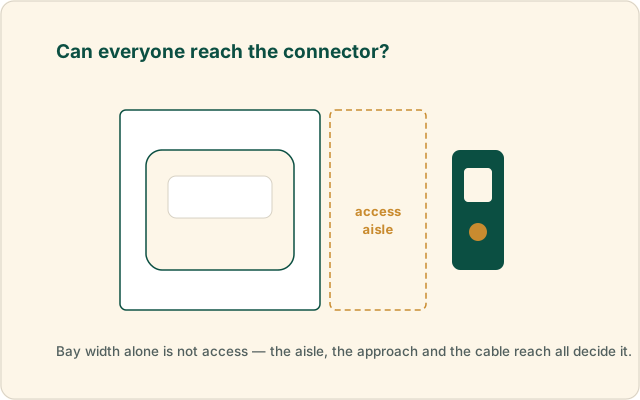
Almost every EV charging layout we are shown has been drawn around two things: where the vehicles turn, and where the cable reaches. Both are necessary. Neither asks whether the person charging can get out of the car, reach the screen, and pay.
That question has a legal dimension in India, and it arrives through a different door from the one operators watch. It is not in the electricity rulebook. It sits in disability law and in the building and local-authority approvals your site needs anyway — which is precisely why it tends to be discovered late, when the concrete is already down.
Where the requirement actually comes from
Three instruments matter, and none of them is an EV document:
- the Rights of Persons with Disabilities Act, 2016, and the Rules made under it in 2017, which establish accessibility obligations for public facilities;
- the Harmonised Guidelines and Standards for Universal Accessibility in India, 2021, issued by the Ministry of Housing and Urban Affairs with the Department of Empowerment of Persons with Disabilities, which is where the design standards live.
Our own compliance reference states the consequence plainly: public charging locations serving the general public require an accessibility screen covering route, bay, interface, payment and assistance arrangements, alongside the local land, building and fire approvals the site needs regardless. It is recorded there as a site-specific review rather than a national checkbox, and that distinction is the whole practical point.
The five things to screen
Take them in the order a person actually encounters them, because that is the order in which a layout fails.
1. Route
Can someone reach the charging bay from the street, the car park entrance and any associated building without encountering a step, a kerb without a ramp, a gradient that defeats a wheelchair, or a surface that defeats a walking frame? A route is only as accessible as its worst three metres. Drainage channels, cable protectors and the lip at the edge of a concrete pad are the usual offenders, and all three are things charging sites add.
2. Bay
An accessible bay is not a normal bay with a sign on it. It needs space to deploy a ramp or open a door fully and transfer, and that space has to stay clear — which means it cannot be where you put the bollard, the charger plinth or the cable management post. This is the single most expensive thing to get wrong, because the fix is civil work rather than a fitting.
3. Interface
The screen, the connector holster and the emergency stop all have to be reachable and operable from a seated position, and legible to someone who cannot read small low-contrast text. Charger manufacturers mount displays at the height that suits the cabinet, not the user; the height at which a unit sits on its plinth is yours to decide, and it is decided at the foundation stage.
4. Payment
If the only way to start a session is an app on a phone held at arm’s length, or a card reader mounted above reach, the bay is not usable independently no matter how good the ramp is. Payment is part of the accessibility question, not a separate commercial one.
5. Assistance
What happens when the equipment defeats someone anyway? An attended site answers this with a person. An unattended site has to answer it with a working help route — a number that is answered, displayed where someone sitting in the bay can read it. Deciding this late usually means deciding it badly.
Why we are not printing dimensions on this page
You will find pages that give you a single national number for bay width or mounting height. We are not going to, and the reason is method rather than caution.
The dimensional standards live in the Harmonised Guidelines document itself, and what your site must satisfy is settled by the authority that grants your building, parking and occupancy approvals — which is local, and which is the same body whose sign-off you need for the rest of the layout. A figure lifted out of context and quoted on a blog is exactly the kind of number that gets built to and then rejected. Read the standard, and put the question to the authority in writing before the layout is frozen.
That is the same rule this site applies to tariffs and to clause numbers in standards: we will tell you which document governs and what it governs, and we will not retype a figure whose currency we cannot stand behind on the day you read it.
How it meets the rest of your approvals
Accessibility does not arrive as its own permit. It arrives inside the local land-use, building, parking, signage and occupancy approvals that a charging site needs anyway, and it is assessed against the layout you submit. That has one useful consequence and one unpleasant one.
The useful one: you are already in that queue, so raising accessibility at drawing stage costs you nothing extra in process. The unpleasant one: because it is bundled into approvals rather than issued separately, a problem surfaces as a held-up occupancy or completion sign-off — at the point where every other rupee is already committed and the site is not earning.
The approvals sequence, and who holds which gate in your state, is set out in our licences and approvals article and in the state pages of the EV charging rules reference.
Sources
| Claim | Source | Status |
|---|---|---|
| Public charging locations serving the general public require an accessibility screen covering route, bay, interface, payment and assistance arrangements, alongside local land, building and fire approvals | Harmonised Guidelines and Standards for Universal Accessibility in India 2021; Rights of Persons with Disabilities Act 2016; Rights of Persons with Disabilities Rules 2017 — as recorded in our compliance reference | verified |
| Accessibility is assessed through local land-use, building, parking, signage and occupancy approvals rather than as a separate EV permit | Competent local bodies, per our compliance reference, which records this as requiring site-specific review | verified |
| Specific dimensional standards — bay dimensions, reach ranges, gradients, mounting heights | Held in the Harmonised Guidelines 2021 and settled locally by the approving authority — deliberately not restated here | not published here |
| The five-part screening order, the civil-cost argument and the failure modes described | Advisory method, not a regulatory requirement | advisory opinion |