
Himachal Pradesh is the simplest state in our reference set on the question that costs other applicants the most time, and one of the trickiest on a question most people never think to ask.
1. One utility, one question
Every district in the state — Shimla, Kangra, Mandi, Solan, Kullu, Chamba, Bilaspur, Hamirpur, Kinnaur, Lahaul and Spiti, Sirmaur and Una — is served by Himachal Pradesh State Electricity Board Limited. There is no second licensee to identify, no special-area distribution business to check against, and no regional split.
Compare that with Madhya Pradesh, where three regional DISCOMs mean a wrong application route costs weeks, or Chhattisgarh, where two special-area licensees sit inside the state utility’s map. In Himachal the only open item at this stage is narrower and entirely tractable: confirm the exact HPSEBL electrical subdivision or ESD for the full site address. Our register grades that critical, because it controls the application route and the utility works, and HPSEBL’s own guidance is to confirm the subdivision and the tariff category before filing.
2. The tariff, and who it covers
| Item | Value | Notes |
|---|---|---|
| EV energy charge, FY 2026-27 | ₹6.78/kWh | Base energy only |
| EV fixed charge, FY 2026-27 | Nil | Verify against the first bill and the tariff code |
| Applies to | Public EV charging stations providing charging commercially | Category for non-public models must be confirmed |
| FPPAS | Variable — ₹0.338/kWh in one worked period | March 2026 consumption, billed June 2026. Obtain the circular for your month |
| Lower-voltage supply surcharge | Applies if triggered | Depends on sanctioned voltage and the general conditions |
| Lower-voltage metering surcharge | Applies if triggered | Depends on metering voltage |
| Late-payment surcharge / prepaid rebate | Both apply | Through the tariff general conditions |
Two things about that table deserve more than a glance.
The rate is per kWh, not per kVAh. Himachal bills real energy, so power factor does not ride on the billing unit the way it does in Chhattisgarh or Maharashtra. Combined with a nil fixed charge, the headline structure here is unusually clean.
3. The category conflict
This is the finding that makes Shimla worth a separate guide, and it is a conflict between two official sources rather than a gap in them.
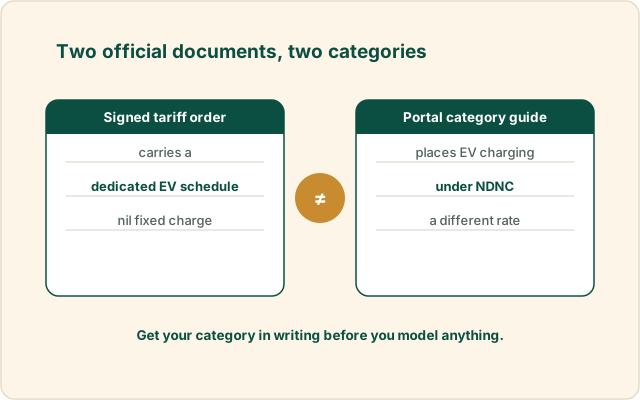
The current signed tariff order carries a dedicated EV schedule. The portal’s tariff-category handout places EV charging under NDNC — the non-domestic, non-commercial category. Both are official. They disagree. Our register grades this entry medium confidence for exactly that reason, and lists resolving it as a critical open item to be put to HPSEBL or HPERC.
Why it matters more than a filing detail: the category decides your energy rate, your fixed charge, and which set of general conditions and surcharges attaches to your bill. A model built on the EV schedule and a connection billed under NDNC are two different businesses, and the difference surfaces on your first invoice, after the capital is spent.
4. What the schedule does not charge
Unusually, the order is explicit about what does not apply to the EV schedule. All four of these are stated Not Applicable:
- Contract-demand violation charge — the penalty other categories pay for exceeding sanctioned demand.
- Power-factor surcharge.
- Disturbing-load penalty.
- Peak-load charge.
For a charging load that is spiky by nature — several fast chargers can coincide for a few minutes and then idle — the absence of a contract-demand violation charge and a peak-load charge is a genuine structural advantage, and it is the opposite of what an operator moving from another state may expect. It is also the kind of favourable term worth confirming still stands in the year you connect, since it lives in the schedule rather than in statute.
5. What it does add
₹6.78 is not a landed cost. Three things sit on top, and only one of them is predictable:
- FPPAS, which varies by consumption and billing period. Our register carries one worked figure — ₹0.338/kWh for March 2026 consumption billed in June 2026 — recorded as an example, not as a rate you can budget. Obtain the circular for your own month.
- The two lower-voltage surcharges, on supply and on metering, each triggered by the tariff’s general conditions according to your sanctioned and metering voltage. This is where the LT-or-HT decision lands in Himachal: not in a different category, as in Chhattisgarh, but in whether these surcharges attach.
- Duties and taxes, which our register does not fix and which must come from the utility.
6. Connection, and the missing clock
The online connection package is specific about what it wants:
- A licensed electrical contractor’s test report.
- Signed non-judicial stamp paper.
- Identity and address evidence, ownership or occupancy evidence, and authorisation records as applicable.
- A PAC certificate where contract demand exceeds 100 kVA. The form also captures preferred voltage and contracted demand, so the sizing decision is made at application time rather than later.
The tariff order also permits a separate EV-charging connection on request for an association, flat or house owner, or other consumer — the route to a dedicated meter rather than charging behind an existing commercial connection.
The money side is worse documented than the process side, and our register says so. The portal handout’s security-deposit table carries an EV row — ₹630 urban, ₹180 rural, ₹85 or ₹125 tribal per kW/kVA — but it is an FY 2025-26 table and is graded official but stale, not decision-grade. The service-connection charges in the same handout are 2021-22 normative LT rates, explicitly flagged do not budget as current. Infrastructure development charges are slab-based with an uncertain date. Get a demand note. Do not build a budget from the handout.
7. No policy, so no subsidy
We could not locate a current official Himachal Pradesh EV-policy document in this research cycle. That entry is graded low confidence and it is an open evidence gap, not a finding that no policy exists — but the practical consequence is the same one either way: no incentive belongs in your base case until the lead department confirms a live window, budget and application channel in writing.
This is the honest difference between Himachal and, say, Chhattisgarh, where a policy statement of 25% capped at ₹10 lakh at least exists to be chased. Here there is nothing to chase until the status is confirmed. Build the model without it.
8. The sequence we would follow
- Confirm the HPSEBL ESD or subdivision for the full site address.
- Resolve the category conflict in writing — dedicated EV schedule or NDNC — naming your use case and connected load. Everything downstream depends on the answer.
- Confirm the schedule reaches your model if it is not public commercial charging.
- Fix the voltage and metering arrangement, knowing that the two lower-voltage surcharges attach through it, and get the PAC route if you are above 100 kVA.
- Get the current FPPAS, duties, taxes and both surcharges so the all-in cost per unit is real rather than ₹6.78.
- Get a demand note for deposit, IDC and service charges. Treat the portal handout as history.
- Confirm the CEI plan-approval, inspection and energisation triggers.
- Confirm fire, land use, building, road access and signage triggers with the local body, Town and Country Planning and the road owner — in a hill town the access and excavation permission is rarely the utility’s to give, and our register lists HPPWD, NHAI or the local road owner as a separate authority for exactly that.
- Ask for a written timeline, since none is published.
What is still unconfirmed
Published deliberately. For Himachal Pradesh we have not verified from a primary source: the exact HPSEBL ESD or subdivision for a given address (critical); whether the dedicated EV schedule applies to a public, captive, fleet, workplace or residential model (critical — the schedule wording is limited to public commercial charging); the current FPPAS, duties, taxes and both lower-voltage surcharges (critical); the portal-versus-order category conflict (critical); the current notified EV policy or written confirmation of its status, and any live incentive window (critical); current security deposit, IDC, service charges and an application-to-energisation timeline (critical — the handout mixes stale periods); voltage, transformer or RMU, metering and PAC requirements for the proposed demand; the CEI plan-approval, inspection and energisation triggers; and the fire, land-use, building, road-access, signage and local-body triggers.
Sources
| Claim | Source | Status |
|---|---|---|
| FY 2026-27 public-commercial EV energy charge ₹6.78/kWh and nil fixed charge; the schedule applies to public EV charging stations providing charging commercially | HPERC / HPSEBL tariff order [HP-TARIFF-2026-001] | verified |
| Contract-demand violation charge, power-factor surcharge, disturbing-load penalty and peak-load charge are stated Not Applicable for the EV schedule; lower-voltage supply and metering surcharges, late-payment surcharge and prepaid rebate apply through the general conditions | HPERC / HPSEBL tariff order [HP-TARIFF-2026-001] | verified |
| The portal tariff-category handout places EV charging under NDNC while the current signed order carries a dedicated EV schedule | HPSEBL portal handout vs HPERC order [HP-CONN-CAT-001] — recorded as a source conflict, medium confidence | source conflict |
| FPPAS is variable; March 2026 consumption carried ₹0.338/kWh in June 2026 bills | HPSEBL FPPAS circular [HP-FPPAS-2026-001] — one period, not a budgetable rate | verified example |
| Connection package requires a licensed electrical contractor test report and signed non-judicial stamp paper; PAC certificate above 100 kVA contract demand; applicants must confirm subdivision and category before filing | HPSEBL connection documents and guidance [HP-CONN-DOC-001], [HP-CONN-WEB-001] | verified |
| Security deposit, IDC and service-connection charges in the portal handout are stale (FY 2025-26 and 2021-22 periods) and not decision-grade; no connection timeline is fixed in this evidence set | HPSEBL fee handout [HP-CONN-FEE-001]; timeline requires authority confirmation | stale / unconfirmed |
| No current official Himachal Pradesh EV policy PDF was located; incentive eligibility and policy tenure must be confirmed | Open evidence gap against [HP-HPERC-WEB-001] — low confidence | open question |
| Sequencing advice, the reading of the category conflict as the highest-value question, and the road-access observation | Advisory method | advisory opinion |