
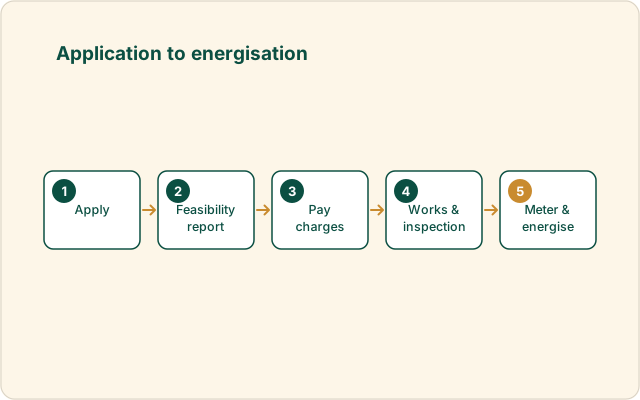
Ask three operators how long a connection takes and you will get three answers, all of them honest, none of them comparable. The reason is that the published clocks differ by a factor of fifty across states — and that none of them start when you think they do.
The clocks that are actually published
Two states in our reference publish statutory timelines in enough detail to plan against. They are not close to each other.
| Where | Situation | Time limit |
|---|---|---|
| Goa and Puducherry (JERC supply code) | Metro cities, existing network | 3 days |
| Urban and municipal areas | 7 days | |
| Rural areas | 15 days | |
| Where extension works, transformer enhancement, extension of mains or a new substation is needed | Not exceeding 90 days | |
| Haryana (Right to Service) | Supply feasible from the existing network | 30 working days |
| LT requiring network expansion or enhancement | 30 working days | |
| 11 kV connections | 71 working days | |
| 33 kV connections | 97 working days — and 167 above 33 kV |
Read the two extremes together: a straightforward urban connection in Goa is a three-day statutory obligation, while a 33 kV connection in Haryana is a ninety-seven-working-day one. Both are the rule, not the exception, and the difference is not efficiency — it is that they are measuring different jobs. Which is the first practical lesson: your timeline is set by the voltage you need far more than by the state you are in.
Notice too what the Haryana schedule implies. Moving from LT to 11 kV more than doubles the statutory clock, and moving to 33 kV more than triples it. If you are weighing an LT or HT connection on tariff arithmetic alone, this is the column that the arithmetic leaves out.
The clock starts when the application is complete, not when you file it
Every one of those limits is expressed the same way: from receipt of an application complete in all respects, with charges and documents. That phrase is doing all the work.
An incomplete application does not run a slow clock. It runs no clock. The elapsed time operators actually experience is almost entirely the period before the utility agrees the file is complete — and that period is the one part of this process you fully control.
The JERC code gives you a way to prove the clock has started: an acknowledgement carrying a registration number must be issued within 24 hours of a complete application. That acknowledgement is the document to keep. It is the difference between a deadline you can point to and a conversation about when you applied.
There is a penalty, and it is small but real
Under the JERC supply code applying in Goa and Puducherry, a distribution licensee that fails to supply within the specified period is liable to a penalty not exceeding five hundred rupees for each day of default.
Do not model this as compensation — against the carrying cost of a stalled charging site it is immaterial. Model it as leverage. A published penalty converts a request for an update into a reference to a specific obligation with a specific consequence, which is a different conversation.
Route it to the right office before you file anything
Our Haryana reference makes the point bluntly: an application must be routed to the licensee only after the full site address and the serving office or subdivision are confirmed. Filing into the wrong subdivision is not a delay of days.
Haryana also publishes who owns the file, which is unusually useful. For LT and 11 kV connections the designated officer is the SDO (Operations), with the XEN (Operations) as first grievance authority and the SE (Operations) as second. For 33 kV and above, the XEN is the designated officer, escalating to the SE and then the Chief Engineer (Operations). Applications route through the Antyodaya Saral portal or DHBVN’s own e-connection portal.
Knowing the escalation ladder before you need it is worth more than knowing the timeline. Most connection delays are resolved by asking the right person once, not by asking the wrong person repeatedly.
Metering, and a trap specific to charging loads
Under the JERC code, no connection is given without a meter, and that meter must be a smart pre-payment or pre-payment meter; any exception requires the Commission’s approval with recorded justification. A separate meter and the correct commission-approved tariff pathway must be confirmed for the charging arrangement — charging load sitting behind a premises meter on a premises tariff is a different commercial animal from a station on an EV category.
Then the trap. Where recorded maximum demand exceeds sanctioned load in a month, that billing cycle is computed on the actual recorded maximum demand, the consumer is informed by SMS or app, and where the sanctioned limit has been exceeded at least three times in a financial year the sanctioned load is revised upward.
This matters more for charging than for almost any other load, because fast charging is spiky by nature: a handful of simultaneous sessions can push recorded demand well above the average the site was sized on. Under-declaring sanctioned load to reduce a demand charge therefore has a short and self-correcting life — three exceedances and the sanction moves to meet reality, with the higher standing charge that implies. Size the sanction to the load you will actually draw.
What you will be asked for
Document lists are licensee-specific and change, so treat this as the shape rather than the list. Under the JERC code, applications up to 10 kW carry a photograph of the applicant, identity proof, and proof of ownership or occupancy of the premises; above 10 kW and for modifications, further documents apply. One helpful provision: where an agreement between licensee and consumer is required, it forms part of the application and no separate agreement is needed.
Applications may be submitted in hard copy or electronically; a hard copy must be scanned and uploaded. Several states publish a licensed-contractor list — Madhya Pradesh’s eastern DISCOM does, alongside its LT and HT new-connection routes, load-change tracking and service-charge payment — and using a listed contractor removes one common reason for a file to be sent back.
A sequence that respects the actual dependencies
- Confirm the licensee and the serving subdivision from the full site address. Do not file before this.
- Settle the connection voltage, because it sets your statutory clock as well as your tariff.
- Size the sanctioned load to real expected demand, not to the number that minimises the standing charge.
- Assemble the complete file — documents, charges, contractor certification — before submitting anything.
- Submit, and keep the dated acknowledgement and registration number.
- Run the electrical inspectorate approval in parallel, not after. It is a separate gate and it decides when you may energise.
The one thing worth repeating: steps 1 to 4 are yours, and they are where the time goes. The statutory limit only governs step 5 onward.
Sources
| Claim | Source | Status |
|---|---|---|
| Haryana statutory limits in working days from receipt of a complete application with charges and documents: 30 where supply is feasible from the existing network; 30 for LT requiring network expansion or enhancement; 71 for 11 kV; 97 for 33 kV; 167 above 33 kV | DHBVN notification of service timelines and authorities under the Haryana Right to Service Act 2014 [HR-RTS-2014-001] | verified |
| Haryana designated officers and escalation: SDO (Operations) for LT and 11 kV with XEN then SE as grievance authorities; XEN for 33 kV and above, escalating to SE then Chief Engineer (Operations); applications via the Antyodaya Saral portal or DHBVN e-connection | [HR-RTS-2014-001] | verified |
| An application must be routed to the licensee only after the full site address and serving office or subdivision are confirmed | DHBVN portal record [HR-DHBVN-WEB-001] | verified |
| JERC timelines where supply can be provided from the existing network: 3 days metro cities, 7 days urban and municipal, 15 days rural, 30 days rural areas of islands; not exceeding 90 days where extension works, transformer enhancement, extension of mains or a new substation is required | JERC (Goa and UTs) Electricity Supply Code Third Amendment 2024 [GA-SC-AMD3-2024-001] / [PY-SC-AMD3-2024-001] | verified |
| Penalty not exceeding five hundred rupees per day of default where the licensee fails to supply within the specified period | [GA-SC-AMD3-2024-001] / [PY-SC-AMD3-2024-001] | verified |
| Acknowledgement carrying a registration number to be issued within 24 hours of a complete application; hard-copy applications to be scanned and uploaded; up to 10 kW requires a photograph, identity proof and proof of ownership or occupancy; any required agreement forms part of the application | [GA-SC-AMD3-2024-001] / [PY-SC-AMD3-2024-001] | verified |
| No connection without a meter, which must be a smart pre-payment or pre-payment meter unless the Commission approves an exception with recorded justification; billing on actual recorded maximum demand where it exceeds sanctioned load, with SMS or app notification, and revision of sanctioned load after at least three exceedances in a financial year | [GA-SC-AMD3-2024-001] / [PY-SC-AMD3-2024-001] | verified |
| A separate meter and the applicable commission-approved tariff pathway must be confirmed for the charging arrangement | Ministry of Power / JERC / utility [NAT-MOP-2024-001] | verified |
| MPEZ publishes LT and HT new-connection routes, a licensed-contractor list, service charges and load-change tracking | Madhya Pradesh Poorv Kshetra Vidyut Vitaran Company portal record [MP-MPEZ-WEB-001] | verified |
| The sequencing advice, the reading of “complete in all respects” as the controllable variable, and the argument for sizing sanctioned load to real demand | Advisory method, not a regulatory requirement | advisory opinion |