
Somewhere between choosing the site and ordering the equipment, someone will tell you that high tension is cheaper once you are drawing real load. It is repeated often enough to feel like a law of nature.
It is not a law. It is a claim about two numbers, and on the tariffs this site has verified it is true in some states, false in at least one, and uncomputable in another because the schedule leaves the relevant cell blank. The good news is that where it can be settled, it can be settled exactly — with one division.
What you are actually choosing between
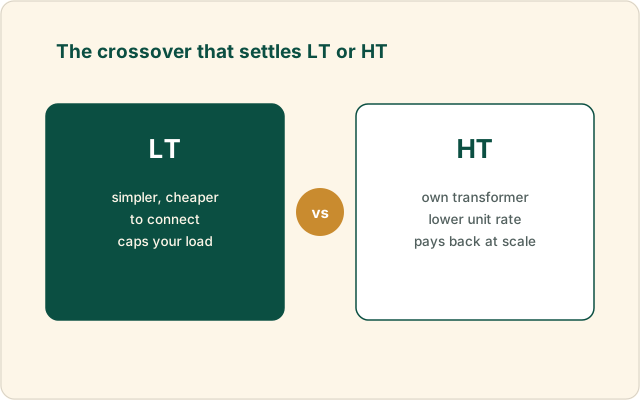
An LT and an HT connection differ on two tariff lines that move in opposite directions:
- a standing monthly charge — fixed or demand-based, usually per kVA of sanctioned or recorded demand, payable whether or not you sell a single unit; and
- a variable rate per unit, which is normally lower at higher voltage because there are fewer losses between the grid and your meter.
So HT typically asks you to pay more every month in exchange for paying less per unit. That trade has an exact break-even, and it is the only honest way to answer the question.
The one line of arithmetic
… giving units per kVA of billing demand per month. Above it, HT wins on tariff. Below it, LT does.
Run it on Goa, where both routes carry a real monthly charge and every input is published:
| LT | HT | Difference | |
|---|---|---|---|
| Energy | ₹5.45/kVAh | ₹4.75/kVAh | HT saves ₹0.70 |
| Fixed charge | ₹25/kVA/month | ₹120/kVA/month | HT costs ₹95 more |
₹95 ÷ ₹0.70 = about 136 kVAh per kVA of billing demand per month — roughly 4.5 kVAh per kVA per day. On a 100 kVA connection that is about 13,600 kVAh a month before HT starts paying for itself. Whether your site will do that is a demand question, and it is now the only question: the tariff argument is closed.
That is the shape of a good answer. A threshold you can test against a forecast beats an opinion about what is cheaper at scale.
Three states where the standard advice breaks
Maharashtra — where HT is dearer, not cheaper
On MSEDCL’s FY 2026–27 EV categories, both LT VIII and HT IX carry no fixed or demand charge at all. With no standing charge on either side, the break-even formula has nothing to trade off — the decision collapses to whichever variable rate is lower. And here it goes the wrong way:
| Route | Total variable |
|---|---|
| LT VIII | ₹9.26/kVAh |
| HT IX, taken at HT | ₹9.73/kVAh (₹8.92 energy + ₹0.81 wheeling) |
| HT IX, taken at EHV | ₹8.92/kVAh |
Read that carefully, because it inverts the usual advice. Taking HT supply at HT voltage costs ₹0.47/kVAh more than staying on LT, with no monthly saving anywhere to recover it — there is no volume at which it becomes the cheaper option. The saving only appears at EHV, which is a different and much larger class of connection.
“Go HT once you are drawing real load” is, on these published numbers, simply wrong in Maharashtra unless you are going all the way to EHV.
Telangana — where LT’s advantage is having no toll at all
Telangana’s LT-IX carries nil fixed charge; HT-IX carries ₹100 per kVA per month. Because the LT side of the subtraction is zero, the whole ₹100 is the price of admission to HT, and it is owed in full in every month the site underperforms.
On a 320 kVA connection that is ₹32,000 a month before a single vehicle plugs in. The right way to read that is as a risk question rather than a price question: HT suits a site you are confident will run hard from month one, LT suits a site that has to build demand. The Hyderabad guide works through the same choice on a real city.
Haryana — where the sum cannot be done
HT energy at ₹7.24/unit is ₹0.24 cheaper than LT at ₹7.48. That is the numerator of nothing useful, because the fixed-charge and minimum-monthly-charge cells in the schedule are blank. A blank is not a nil. Without the standing charges there is no break-even to compute, and the honest position is that the question is open until the licensee answers it in writing.
If someone hands you a Haryana model that assumes those cells are zero, they have made a decision on your behalf and not told you.
What the arithmetic does not cover
Four things sit outside the tariff comparison and can outweigh it:
- You may not get to choose. Utilities route by load. Goa’s GED portal takes LT applications up to 90 kW and HT above 90 kW — and our Goa reference records the treatment of the 90–150 kW band as an open question, so an installation in that range should be settled with the utility before equipment is specified, not after.
- The connection cost is separate. HT generally means your own transformer, switchgear, protection and the space and civil work to house them, plus whatever augmentation the network needs. None of that is in the per-unit comparison, and it is usually the larger number in year one.
- Sanctioned load is a commitment, not a target. Under the JERC supply code that applies in Goa and Puducherry, if recorded maximum demand exceeds sanctioned load the billing cycle is computed on actual recorded demand, and exceeding the sanctioned limit three times in a financial year leads to a revision of the sanction. Under-declaring to reduce a demand charge is a strategy with a short life.
- The demand base itself. A standing charge levied per kVA of recorded demand and one levied per kVA of sanctioned load behave very differently for a spiky load like fast charging. Confirm which basis applies before you model it.
How to decide it in practice
- Get both routes’ standing charge and variable rate from the current schedule for your licensee, and note any blank cells as unknowns.
- If either variable rate is not lower at HT, stop — there is no break-even and HT has to justify itself on reliability or capacity, not cost.
- Otherwise divide, and get your threshold in units per kVA per month.
- Compare it against a demand forecast you would be willing to show a lender, not against a best case.
- Add the connection and transformer cost of the HT route separately, and check whether the per-unit saving repays it inside your horizon.
Sources
| Claim | Source | Status |
|---|---|---|
| Goa: LT energy ₹5.45/kVAh with ₹25 per kVA per month fixed; HT energy ₹4.75/kVAh with ₹120 per kVA per month fixed | JERC — Goa MYT and Retail Tariff Order FY 2025-26 to FY 2029-30 [GA-TARIFF-2025-001] | verified |
| Goa break-even of approximately 136 kVAh per kVA of billing demand per month (₹95 ÷ ₹0.70), and the per-day and 100 kVA illustrations derived from it | Computed from the verified Goa figures above | model-derived |
| MSEDCL FY 2026-27: LT VIII and HT IX both carry nil fixed/demand charge; LT VIII total variable ₹9.26/kVAh; HT IX ₹8.92 energy + ₹0.81 wheeling = ₹9.73/kVAh at HT; ₹8.92/kVAh at EHV | MERC — MSEDCL Order, Case 75 of 2025 post-remand [MH-TARIFF-2026-001] | verified |
| The ₹0.47/kVAh HT-over-LT difference in Maharashtra and the conclusion that no volume recovers it at HT voltage | Computed from the verified MSEDCL figures above | model-derived |
| Telangana: LT-IX nil fixed charge; HT-IX ₹100 per kVA per month; ₹32,000 per month on a 320 kVA connection | TGERC — Retail Supply Tariff Schedule FY 2026-27 [TS-TARIFF-2026-001]; the 320 kVA figure is an illustration computed from it | verified / model-derived |
| Haryana: HT energy ₹7.24 and LT ₹7.48 per unit; fixed charge and minimum monthly charge blank in the schedule | UHBVN Schedule of Tariff FY 2026-27 [HR-TARIFF-2026-001] — blanks recorded in our reference as unconfirmed, not nil | verified / unconfirmed |
| Goa GED routes LT applications up to 90 kW and HT above 90 kW; treatment of the 90–150 kW band is unresolved | GED portal record [GA-GED-PORTAL-WEB-001]; recorded in our Goa reference as an open question | verified / unconfirmed |
| Billing on actual recorded maximum demand where it exceeds sanctioned load, and revision of the sanction after three exceedances in a financial year | JERC (Goa and UTs) Electricity Supply Code Third Amendment 2024 [GA-SC-AMD3-2024-001] — applies in Goa and Puducherry | verified |
| The break-even method, the decision sequence, and the treatment of connection cost as a separate question | Advisory method, not a regulatory requirement | advisory opinion |