
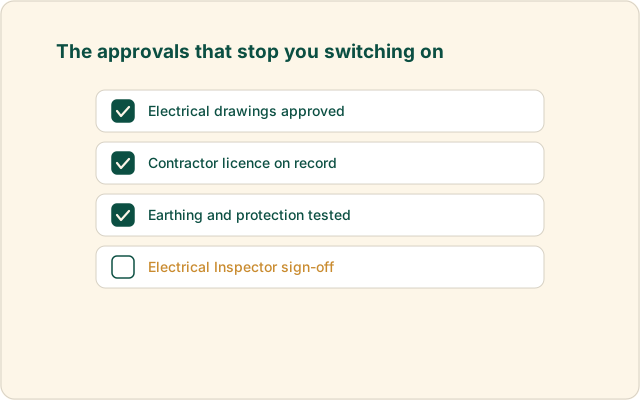
Most people building a charging station track one approval queue: the DISCOM. It is the one with the money attached, and the one everybody warns you about.
There are three queues. The second is the electrical inspectorate, and it holds a gate the DISCOM does not: permission to energise. The third is the local authority — fire, building, occupancy — and it holds the gate on opening at all. Both are commonly discovered after the equipment is standing on the pad.
Three gates, three different bodies
| Gate | Who holds it | What it stops |
|---|---|---|
| Supply | Your distribution licensee | Getting a connection and a meter |
| Safety and energisation | Chief Electrical Inspector / CEIG | Being allowed to charge the installation |
| Site and occupancy | Local fire, building, planning and municipal authorities | Opening to the public |
These run partly in parallel and they do not share a queue. A sanctioned connection does not imply an inspected installation, and an inspected installation does not imply an occupancy approval. Our Maharashtra reference marks the inspectorate step as a critical open question to settle per site — competent office, drawing thresholds, contractor and test certificates, fees and inspection stages — precisely because it is the one that is routinely assumed rather than confirmed.
The national safety layer
The Central Electricity Authority (Measures relating to Safety and Electric Supply) Regulations, 2023 apply to AC and DC charging installations in addition to whatever your state and licensee require. Our Telangana reference records that regulations 123–128 apply there alongside state supply and inspection requirements; our Maharashtra reference states the same principle — CEA safety regulations apply in addition to utility, inspectorate, fire, building and site requirements, not instead of them.
The practical content, as our compliance reference puts it, is that installations must meet the relevant CEA electrical-safety protections, testing and record-retention duties, and that final design and energisation require qualified professionals and competent-authority acceptance where triggered. Two words in that sentence do real work. Record-retention means the test certificates are not paperwork you discard after inspection. Where triggered means the thresholds are local — which is why nobody can hand you a national answer.
What the inspectorate gate actually looks like
Maharashtra is the clearest published example. The Chief Electrical Inspector publishes two distinct online applications, routed through MahaOnline:
- plan approval of the electrical installation — before you build it; and
- inspection and permission for charging of the electrical installation — before you energise it.
Note the sequence that implies. The drawings are approved first, the installation is inspected second, and only then may it be charged. A project that orders equipment and pours foundations before the first of those is betting that the approved design will match what it has already built.
Telangana adds a threshold worth knowing if your site sits in or under a building: TGSPDCL guidance requires premises dues clearance, completed safe wiring, earthing and the required consumer-provided accessories, payment for augmentation where applicable, and CEIG approval for multi-storeyed buildings of at least 15 metres. Basement and podium charging in a tall building is therefore a different approvals problem from the same chargers on open ground.
The costs nobody budgets for
Madhya Pradesh publishes an unusually specific list of safety and spatial requirements for charging stations, and it is worth reading even if you are building elsewhere — not because it binds you, but because it is a realistic inventory of what a serious safety case contains:
- climate control equipment and liquid-cooled cables, as required;
- main electrical panels — HT, LT, main power distribution, DG changeover and main supply — protected by an in-cabinet clean-agent gas fire suppression system;
- transformer safety precautions per the CEA safety regulations;
- a robust fire suppression system plus an automated emergency button linked to the nearest fire department;
- CCTV surveillance;
- spatial requirements per the MP Bhumi Vikas Rules 2012 and later amendments.
Count how many of those appear in a typical vendor quotation. In our experience reading supplied quotations, in-cabinet suppression, the fire-department link and the civil consequences of the spatial rules are the three most often missing — and they are not small items. A capital plan that omits them is not wrong by a rounding error; it is missing a category.
The local gate, and the one timeline that is published
The third queue is the most site-specific and the least generalisable: fire, building, planning, parking, signage, access, road and occupancy approvals, held by competent local authorities and varying parcel by parcel. Our state references list them as authorities to confirm rather than as a checklist, because a checklist here would be a fiction.
One published timeline is worth holding on to: Madhya Pradesh’s policy states that existing resident welfare associations should process NOCs within seven working days. If you are installing in or under an existing building, the RWA consent is a real dependency with a real clock, and it is better raised in week one than in month four.
How to sequence it
- Identify all three bodies for your specific parcel before spending on design — licensee, inspectorate office, and the local authorities the layout triggers.
- Ask the inspectorate, in writing, for its drawing threshold, required contractor and test certificates, fee schedule and inspection stages. This is the answer our own reference marks as critical and unresolved for most states.
- Get plan approval before you build, not after.
- Budget the safety scope explicitly — suppression, monitoring, emergency linkage and the civil work the spatial rules imply.
- Treat energisation permission as the milestone, not delivery of the chargers.
The commercial reason to care is simple. Between equipment delivery and energisation permission, you are holding depreciating assets and, usually, servicing debt, on a site earning nothing. That interval is a financing cost, and it is one of the intervals a lender will ask you to justify.
Sources
| Claim | Source | Status |
|---|---|---|
| CEA (Measures relating to Safety and Electric Supply) Regulations 2023 apply to AC and DC charging installations; final design and energisation require qualified professionals and competent-authority acceptance where triggered, with testing and record-retention duties | Central Electricity Authority [NAT-CEA-2023-001], as recorded in our compliance reference | verified |
| CEA regulations 123–128 apply in Telangana in addition to state supply and inspection requirements | Central Electricity Authority [NAT-CEA-2023-001], per our Telangana reference | verified |
| CEA safety regulations apply in addition to Maharashtra utility, CEI, fire, building and site requirements | Central Electricity Authority [NAT-CEA-2023-001], per our Maharashtra reference | verified |
| CEI Maharashtra publishes separate online applications for electrical-installation plan approval and for inspection and permission for charging/energisation, directing applicants to MahaOnline | Chief Electrical Inspector Maharashtra [MH-CEI-WEB-001], [MH-CEI-FORM-001], [MH-CEI-FORM-002] | verified |
| TGSPDCL requires premises dues clearance, completed safe wiring, earthing, required consumer-provided accessories, payment for augmentation where applicable, and CEIG approval for multi-storeyed buildings of at least 15 m | TGSPDCL [TS-TGSPDCL-FORM-006] | verified |
| Madhya Pradesh safety and spatial requirements: climate control equipment and liquid-cooled cables as required; main panels protected by in-cabinet clean-agent gas fire suppression; transformer safety per CEA; fire suppression plus an automated emergency button linked to the nearest fire department; CCTV; spatial requirements per MP Bhumi Vikas Rules 2012 and later amendments | MP EV Policy Operational Guidelines 2025 [MP-EV-GUIDE-2025-001] | verified |
| EV-ready premises should provide simultaneous charging-point load with a 1.25 safety factor; existing RWAs should process NOCs within seven working days | Madhya Pradesh Electric Vehicle Policy 2025 [MP-EV-2025-001] | verified |
| Which items are most often missing from supplied vendor quotations | Our experience reading supplied quotations — an advisory observation, not a survey | advisory opinion |
| The three-gate framing, the recommended sequence, and the financing-cost argument for treating energisation as the milestone | Advisory method, not a regulatory requirement | advisory opinion |