
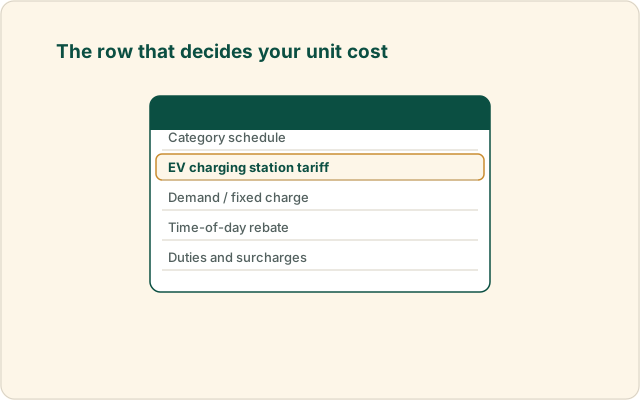
Ask what electricity costs at a charging site and you will be given one number. It is almost always the energy charge, and the energy charge is almost never what you pay.
This is not a trick played on outsiders. Tariff orders are written for regulatory precision, not for readability, and the number a business case needs — the landed cost of a delivered unit — is not printed anywhere in them. It has to be assembled. Here is how to assemble it, using tariffs this site has already archived against their orders.
1. There is more than one variable charge
Start with the case that makes the point without any arithmetic on your part. Maharashtra’s MSEDCL schedule for FY 2026–27, category LT VIII (EV Charging Station), publishes these lines:
| Line in the schedule | Value |
|---|---|
| Fixed / demand charge | Nil |
| Energy charge | ₹7.73/kVAh |
| Wheeling charge | ₹1.52/kVAh |
| Stated total variable | ₹9.26/kVAh |
Someone who quotes “the Maharashtra EV tariff” as ₹7.73 and someone who quotes it as ₹9.26 are both reading the same official page. The gap between them is ₹1.53/kVAh — roughly a fifth of the cost — and it is entirely a question of which line was copied. Wheeling is not an optional extra; it is what it costs to move the unit to you.
2. Check the unit before you compare anything
Two published EV-charging rates, both current, both verified against their orders:
| State and category | Rate | Unit |
|---|---|---|
| Telangana — LT-IX, EV charging stations | ₹6.00 | per kWh |
| Maharashtra — LT VIII, total variable | ₹9.26 | per kVAh |
These cannot be subtracted from one another. kWh bills real energy; kVAh bills apparent energy, which means it charges you for your power factor as well as your consumption. On a kVAh tariff, poor power factor is not a penalty line at the bottom of the bill — it is baked into every unit, silently, all year.
Converting one to the other at parity, which is the intuitive thing to do, always understates cost on the kVAh side. If you take one habit from this page, take this one: read the unit before you read the number.
3. Fixed, demand, nil, and blank — four different things
The monthly charge you owe before selling anything varies more between states than the energy rate does, and it is the component that decides how much risk a slow launch carries.
| State | Standing monthly charge | What it means for a slow start |
|---|---|---|
| Maharashtra — LT VIII and HT IX | Nil | No monthly toll while demand builds |
| Telangana — LT-IX | Nil fixed | Same, on the LT route |
| Telangana — HT-IX | ₹100 per kVA per month | Payable whether you sell anything or not |
| Goa — LT / HT | ₹25 / ₹120 per kVA per month | Both routes carry a real monthly charge |
| Haryana — the EV schedule | Blank in the schedule | Unknown, not zero |
The last row is the one that costs people money. A blank cell in a tariff schedule is not a published nil. Maharashtra’s nil is a stated nil — you can model it. Haryana’s blank is an absence of information, and the honest treatment is to ask the licensee in writing rather than to assume the favourable reading. The two look identical in a spreadsheet and are completely different in reality.
4. “Time of day” means three different mechanisms
Every state has time-of-day pricing and no two express it the same way. All three of these are current and all three are in our reference:
| State | Mechanism | As published |
|---|---|---|
| Telangana | Flat rupee adders | Peak +₹1.50/kWh; solar −₹0.50/kWh |
| Madhya Pradesh | Symmetric percentages | ±20% on the base rate |
| Maharashtra | Seasonal percentages | Solar 09:00–17:00 −15% Apr–Sep and −25% Oct–Mar; peak 17:00–24:00 +20%; 00:00–09:00 0% |
The difference is not cosmetic. A rupee adder is fixed no matter how high the base rate goes; a percentage scales with it, so a tariff revision changes your peak exposure automatically. And a seasonal rebate means the same site has two different winter and summer economics, which a single annual average will hide completely.
For a charging station this is the component most likely to decide the business, because your demand curve is not yours to choose. A site whose traffic arrives in the evening peak is running a structurally different business from one that fills during solar hours, on the identical tariff.
5. Read the cover, not just the table
Four questions to settle before you trust any rate you have found:
- Which licensee? A state tariff is not automatically your tariff. Our Maharashtra reference carries an explicit caveat that the figures are MSEDCL’s and that other licensees must be confirmed — which matters enormously in Mumbai, where more than one licensee operates.
- Which period? The MSEDCL figures above run 1 April 2026 to 31 March 2027. A tariff order has a life, and a superseded order is a wrong number rather than an old one.
- Which voltage? Maharashtra’s HT IX shows ₹8.92/kVAh at EHV, and ₹8.92 energy plus ₹0.81 wheeling — ₹9.73 — at HT. Same category, different answer by connection voltage.
- What is not in the order at all? Fuel and power purchase cost adjustments, electricity duty, and any local cess sit outside the schedule and move independently. They are real money and they are not in the table you are reading.
The five-line version
- Find every variable line, not just the energy charge. Add wheeling.
- Read the unit. kWh and kVAh are not the same thing and never net out.
- Record the standing monthly charge, and treat a blank as unknown.
- Write down the time-of-day mechanism, not just the fact that one exists.
- Note the licensee, the voltage and the validity period next to the number.
Do that and you have a defensible input. What you do not yet have is a landed cost — duty and fuel adjustments still sit on top, and only your licensee can confirm them for your connection.
Sources
| Claim | Source | Status |
|---|---|---|
| MSEDCL FY 2026-27 LT VIII (EV Charging Station): nil fixed/demand; energy ₹7.73/kVAh; wheeling ₹1.52/kVAh; stated total variable ₹9.26/kVAh, with displayed components summing to ₹9.25 | MERC — MSEDCL Order, Case 75 of 2025 post-remand [MH-TARIFF-2026-001], effective 1 Apr 2026 to 31 Mar 2027 | verified |
| MSEDCL HT IX: nil fixed/demand; EHV total variable ₹8.92/kVAh; HT energy ₹8.92 plus wheeling ₹0.81 = ₹9.73/kVAh | MERC [MH-TARIFF-2026-001] | verified |
| Maharashtra time of day: solar hours 09:00–17:00 −15% Apr–Sep and −25% Oct–Mar; peak 17:00–24:00 +20%; 00:00–09:00 nil | MERC [MH-TARIFF-2026-001]; category eligibility to be confirmed | verified |
| Telangana LT-IX energy charge ₹6/kWh with nil fixed charge; HT-IX ₹100 per kVA per month; time-of-day adjustments of +₹1.50/kWh peak and −₹0.50/kWh solar | TGERC — Retail Supply Tariff Schedule FY 2026-27 [TS-TARIFF-2026-001] | verified |
| Goa fixed charges of ₹25 per kVA per month (LT) and ₹120 per kVA per month (HT) | JERC — Goa MYT and Retail Tariff Order [GA-TARIFF-2025-001] | verified |
| Madhya Pradesh symmetric ±20% time-of-day blocks on the base rate | MPERC — Retail Supply Tariff Order FY 2026-27 [MP-TARIFF-2026-001] | verified |
| Haryana: fixed charge and minimum monthly charge appear blank in the schedule | UHBVN Schedule of Tariff FY 2026-27 [HR-TARIFF-2026-001] — recorded in our reference as unconfirmed, not as nil | unconfirmed |
| The reading method, the ordering of the checklist, and the interpretation of a blank cell as unknown rather than nil | Advisory method, not a regulatory requirement | advisory opinion |