
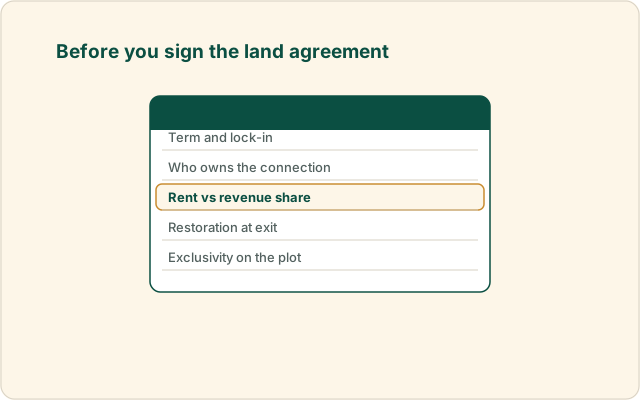
The usual sequence is this: an operator or a franchise seller approaches you, presents a single structure — commonly a fixed monthly rent, or a share of revenue — and the conversation becomes about the number. Higher or lower. Longer or shorter.
That framing costs landowners money, because it treats a structural question as a price question. Before you negotiate the number, work out whether that is even the structure you want.
The routes actually available to you
Land is necessary but not sufficient: the site still has to support access, parking, power, demand, approvals, and a commercial structure that pays for the risk being taken. Depending on how much of that risk you want, and how much capital you are willing to put in, the realistic routes are:
| Route | Who carries the risk |
|---|---|
| Fixed lease to an operator | Operator. You take a predictable rent and no upside. |
| Minimum guarantee plus revenue share | Shared. A floor for you, with participation above it. |
| Pure revenue share | Mostly you. No floor — if the station underperforms, so do you. |
| Landowner-funded, CPO-operated | You fund, they run. You take the returns and the capital risk. |
| Investor and landowner joint venture | Shared, per the agreement. |
| Owner-operated charging site | Entirely you — capital, operations and demand risk. |
| Fleet depot or captive charging | Depends on the offtaker; often the most predictable demand. |
| Reject or hold the site | Nobody. A real option, and sometimes the right one. |
The questions that decide it
1. Does the site have the power?
Ask this before anything commercial. A charging station is a connected-load business, and if your plot needs a transformer or a long cable run to reach adequate supply, that cost has to come from somewhere — and it will shape what anyone is willing to pay you. An operator who has not checked this has not valued your site; they have valued its location on a map.
2. What is the term, and what happens at the end?
Who owns the equipment when the agreement ends? Who removes it, and who restores the surface? If the operator walks away in year three, are you left with foundations, a redundant connection and a dispute? These clauses are boring to read and expensive to omit.
3. If it is revenue share, share of what — and how do you verify it?
Revenue share on a number you cannot audit is a promise, not a term. Ask how units are metered, what reporting you receive, how often, and what right you have to verify. A share of gross revenue and a share of net after undefined costs are very different deals.
4. If there is a guarantee, what stands behind it?
The same question that decides franchise offers decides these: a guarantee is only as good as the party giving it and the security behind it. We work through what that looks like in evaluating a franchise offer, where a third of an investor’s total cash rested on an unsecured promise five years out.
5. What are you giving up?
Exclusivity, access, parking your own vehicles, future development rights on the rest of the plot, the ability to sell. An agreement that ties up more of the asset than the charging bays actually need is common and worth catching.
6. If it is public land, is the revenue share accounted for?
Where public land is used, a revenue-share reference of ₹1/kWh applies under the national guidelines. That is a real cost line in the project, and it affects what the site can afford to pay you.
What a serious counterparty will already have
You can learn a great deal about who you are dealing with from what they bring. A serious operator or lender will want, and should already be working from: the plot dimensions or survey, ownership or lease status, road access, current electricity information, photographs, neighbouring uses, and any offer already received.
If someone is proposing terms without having established connected-load dependency or the approvals position, they are either very early or not serious — and in both cases the terms on the table are not yet informed by what your site actually is.
A sensible order of work
- Screen the plot — geometry, electrical sizing, transformer requirement. Cheap, fast, and it can end the question.
- Establish the connection position with the DISCOM.
- Check the approvals layer for your state and parcel — see what approvals actually apply.
- Decide the route from the eight above, based on how much risk and capital you want.
- Only then invite offers, on terms you have chosen rather than terms you were handed.
Inviting two or three offers against a structure you have already decided is a materially stronger position than negotiating the one that found you.
Sources and basis
| Claim | Basis | Status |
|---|---|---|
| Public-land revenue share reference of ₹1/kWh | Ministry of Power — Guidelines for Installation and Operation of EV Charging Infrastructure (2024) | verified |
| The eight routes, what we assess, and what a serious counterparty needs | Our landowner advisory method | advisory method |
| Independence — no franchise sales, no sale of landowner details | Our editorial and data policy; commercial relationships never influence published conclusions | stated policy |