
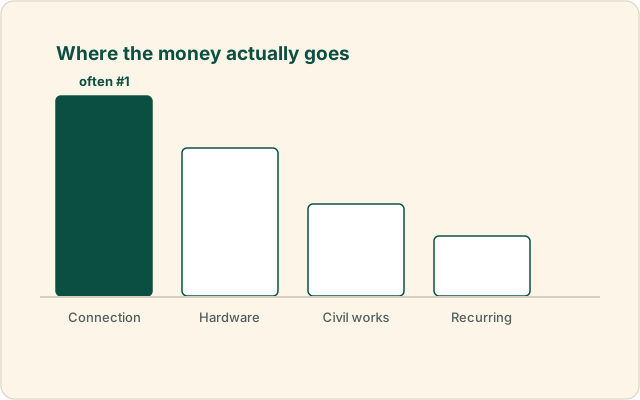
There is no single number, and anyone who gives you one without asking about your site is quoting a hardware price list rather than a project. What we can do — and what this page does — is set out the four blocks a real budget contains, show which of them are fixed by regulation rather than by negotiation, and name the one that most often blows a plan apart.
The four cost blocks
1. The charging hardware
The visible cost, and usually the one that is quoted most accurately, because it comes off a manufacturer’s price list. It scales with power and with connector count: an AC point is a fundamentally different item from a DC fast charger, and a multi-gun DC cluster is different again.
Two things to check on any quotation. First, chargers are listed at 5% GST, but a turnkey package that bundles civil and electrical works may attract different rates on those line items — so the effective tax on the total is not automatically 5%. Ask for the itemised invoice, not the bundled one. Second, a quoted price with no warranty term, no spares commitment and no named service response time is not comparable to one that has them.
2. The electricity connection
This is the block that varies most between two plots on the same road, and it is the one covered least well in vendor quotations — because the vendor does not control it. Your distribution utility does.
What drives it: the sanctioned load you need versus what the existing connection carries, whether a transformer must be added or upgraded, the distance from the nearest adequate feeder, and the DISCOM’s own schedule of charges for the connection work. A site that needs a new transformer and a long cable run to reach it can carry a connection cost in the same order as the hardware itself.
3. Civil and installation works
Foundations, cabling and conduits, earthing, canopy or shelter if you are building one, lighting, signage, bollards and protection, surface work and parking layout. This block is where site geometry turns into money: an awkward plot shape, a long cable route from the supply point, or a surface that has to be broken and reinstated all add cost that a flat, well-positioned plot does not carry.
4. Recurring costs
Electricity, network connectivity and platform fees, maintenance and spares, insurance, land rent or revenue share, cleaning and security. Recurring cost is what turns a good-looking capex case into a bad business, and it is the block most often left out of a one-page projection.
The part that is not negotiable: your margin has a ceiling
This is the piece most first-time investors miss, and it changes how the whole budget should be read. Under the Ministry of Power’s Guidelines for Installation and Operation of Electric Vehicle Charging Infrastructure (2024), what a public charging station may charge is bounded at both ends:
- The supply tariff to a public charging station is capped at the Average Cost of Supply (ACoS) until 31 March 2028.
- The service charge — your margin over the cost of electricity — is subject to ceilings: ₹3/kWh (AC, solar hours) and ₹4/kWh (AC, non-solar hours); ₹11/kWh (DC, solar hours) and ₹13/kWh (DC, non-solar hours).
- Where public land is used, a revenue-share reference of ₹1/kWh applies.
Read that again as a business statement rather than a regulation: your margin per unit is capped, so the only lever you genuinely control is how many units you sell. You cannot price your way out of a bad site. A station on a quiet road does not become profitable by charging more, because it is not permitted to charge much more.
That is why we are so insistent, throughout this site, that site selection and honest throughput assumptions matter more than shaving 5% off a hardware quotation. A 5% hardware saving is a one-time gain. A site that delivers half the expected units is a permanent one.
What your electricity actually costs
The input that matters is the landed cost per grid kWh — the energy charge plus fixed and demand charges plus duty, as it appears on your bill — not the headline energy charge in the tariff schedule. These are routinely confused, and the difference is not small.
A worked illustration of the gap: in Telangana’s FY 2026–27 tariff schedule, the LT-IX category for EV charging stations carries an energy charge of ₹6/kWh. That is a real, published, verifiable number — and it is still not what a unit costs you, because the fixed and demand components and duty sit on top of it. Use your own DISCOM’s effective rate from an actual bill.
Nationally, ACoS varies by state and utility in roughly the ₹6–9/kWh band. We label that as an estimate, not a verified figure, because it is a reference range rather than a published national rate — your state tariff order overrides it in every case.
A labelled reference case, so the scale is not abstract
To make the numbers concrete without pretending they are universal, here is a single real acceptance case that our ROI calculator ships with as its reference scenario. It is one deal, supplied to us, not a market average — treat it as a scale check, not a benchmark:
- 320 kW DC cluster, franchise model
- ₹38,00,000 ex-GST investment, plus 5% GST
- 60-month term, ₹57,000/month minimum guarantee against a 22,800 kWh/month threshold
- ₹2.60/kWh on units above the threshold; 50% buyback after five years; maintenance included
What is instructive about that case is not the headline. Run it through the calculator at a 12% required return and the investment verdict comes back below hurdle — and the reason is that capital recovery depends almost entirely on a month-60 buyback that carries no security. The station is operationally profitable; the investment is only as good as an unsecured promise. That distinction is invisible in a payback-period headline and it is exactly the kind of thing a model should surface.
How to get to a real number for your site
- Establish the connection position first. Sanctioned load, transformer adequacy, distance to an adequate feeder. Until this is known, every total is provisional.
- Get an itemised quotation, not a bundled one, so you can see hardware, civil and electrical separately and check the tax treatment of each.
- Model throughput honestly, and treat utilisation assumptions with suspicion — including ours. The site-type utilisation benchmarks in our own calculator are internal advisory estimates, explicitly not measured industry data, and we label them that way in the tool.
- Judge the deal, not the station. As the reference case shows, a profitable station and a good investment are different questions.
Sources
| Claim | Source | Status |
|---|---|---|
| Supply tariff to public charging stations capped at ACoS until 31 Mar 2028; service charge ceilings ₹3/₹4 per kWh (AC) and ₹11/₹13 per kWh (DC); public-land revenue share ₹1/kWh | Ministry of Power — Guidelines for Installation and Operation of EV Charging Infrastructure (2024) | verified |
| LT-IX EV charging station energy charge ₹6/kWh | TGERC FY 2026–27 Tariff Schedule | verified |
| Chargers listed at 5% GST | CBIC rate schedule, as cited in our ROI calculator’s assumptions | verified |
| ACoS approximately ₹6–9/kWh across states | Reference range; state tariff orders override | estimated |
| Site-type utilisation benchmarks | Internal advisory estimates — not measured industry data | estimated |
| 320 kW cluster DC franchise reference case | Single acceptance case supplied to us; not a market average | user supplied |