
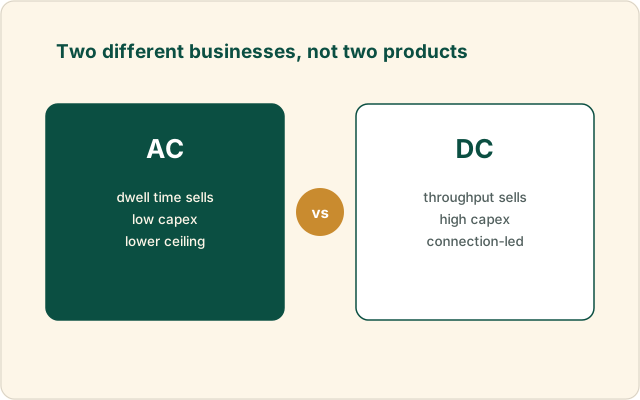
Most AC-versus-DC articles compare charging speed and price. Both matter. But the decision is not primarily a technology decision — it is a decision about how much margin you are permitted to earn per unit, how much electrical load you can actually get, and how long the vehicle will be parked. Get those three right and the hardware follows.
The regulatory fact: your permitted margin differs by more than three times
Under the Ministry of Power’s 2024 guidelines, the service charge — your margin over the cost of electricity — is subject to ceilings, and those ceilings depend on the charger type:
| Charger type | Solar hours | Non-solar hours |
|---|---|---|
| AC | ₹3/kWh | ₹4/kWh |
| DC | ₹11/kWh | ₹13/kWh |
Read what that does to a business case. On the non-solar figures, DC permits ₹13 against AC’s ₹4 — more than three times the margin on the same unit of energy. An AC site therefore has to move a great deal more energy to earn the same rupee, and AC is intrinsically the slower way to move energy.
This does not make AC wrong. It makes AC right for a different situation, which is the actual subject of this article.
What each is genuinely for
AC charging suits long dwell
AC works where the vehicle is parked anyway for hours and charging is a service attached to that stay rather than the reason for it: workplaces, residential parking, hotels, malls with long visits, overnight fleet parking. The vehicle’s onboard charger does the conversion, so the equipment is simpler and the connection demand far lower.
The economics work when you are not paying for the parking — when the land is already yours, or the charging supports a primary business that benefits from people staying longer. As a standalone revenue business on rented land, the capped margin makes it hard.
DC charging suits short stops
DC does the conversion in the unit, delivers energy far faster, and suits places where nobody wants to wait: highway stops, urban transit points, commercial fleet turnarounds. The higher permitted service charge exists precisely because the cost structure is heavier — more expensive equipment, far more connected load, more thermal management, more to maintain.
DC is also where the connection question becomes decisive. A meaningful DC installation can require a sanctioned load that the existing connection cannot support, which means a transformer and possibly a long cable run — a cost that can rival the chargers themselves and that lands before you sell anything.
The four questions that actually decide it
- How long will the vehicle be there? This single question eliminates one option most of the time. Under thirty minutes of intended stop, AC cannot deliver enough energy to be the product. Several hours, and DC’s speed is being paid for and not used.
- What load can this site actually get, and at what cost? Not what you would like — what the DISCOM will sanction for this connection, and what the augmentation costs. This frequently decides the answer on its own.
- What is the vehicle mix you are serving? Two- and three-wheelers, cars, and commercial vehicles have different connector requirements and different energy per session. Serving “everyone” is usually a decision not to serve anyone particularly well.
- Who pays for the land? If land is free to you, AC’s thin margin can still work. If you are paying rent or a revenue share, thin margin plus slow throughput is the combination that fails.
Mixed sites, and why they are often the honest answer
Many real sites end up with a mix: DC for the customers who are stopping to charge and AC for those parked anyway. That is a reasonable design, but it should be an explicit decision with each part justified on its own, not a hedge chosen because the choice was hard.
The test is simple: if you removed the AC points, would you lose revenue you can name? If you removed the DC points, could the site still serve its intended customer? If neither answer is clear, the configuration has not been designed yet.
What we deliberately are not telling you
We are not going to give you a rupee-per-kW capex comparison or a utilisation figure by charger type. Hardware pricing moves and varies by vendor and volume, and the utilisation benchmarks in circulation — including the ones in our own calculator — are internal estimates rather than measured industry data. We label ours as estimates in the tool, and we are not going to launder them into an article as though they were findings.
What is solid is above: the permitted margin, the load implications, and the dwell logic. Those are enough to make the choice correctly.
Sources
| Claim | Source | Status |
|---|---|---|
| Service charge ceilings: AC ₹3/kWh solar and ₹4/kWh non-solar; DC ₹11/kWh solar and ₹13/kWh non-solar | Ministry of Power — Guidelines for Installation and Operation of EV Charging Infrastructure (2024) | verified |
| Supply tariff to public charging stations capped at Average Cost of Supply until 31 March 2028 | Ministry of Power — Guidelines (2024) | verified |
| Utilisation by site type | Internal advisory estimates, labelled as such in our ROI calculator — deliberately not quoted here | estimated |
| Dwell-time and vehicle-mix reasoning | Advisory method, not a regulatory requirement | advisory opinion |